
Rumeli Fortress stands as one of Istanbul’s most impressive historical landmarks, built in just four months in 1452 under Sultan Mehmed II’s orders. Standing proudly on the European shores of the Bosphorus, this massive 30-acre stronghold was constructed with remarkable speed between April 15 and August 31, 1452, specifically to control naval traffic before the conquest of Constantinople.
When exploring this 15th-century hilltop fortress, you’ll discover a fascinating defensive structure featuring four uniquely named towers – Saruca Pasha, Halil Pasha, Zağanos Pasha, and Küçük Zağanos Pasha – along with 13 bastions of various sizes. The imposing Halil Pasha Tower, the largest among them, rises an impressive 28 meters with walls up to 7 meters thick. Meanwhile, the Saruca Pasha and Halil Pasha towers each boast nine floors, with the Zağanos Pasha Tower featuring eight.
We’ve created this comprehensive self-guided tour guide to help you navigate this historical marvel. Throughout this article, we’ll explore the fortress’s rich history, its strategic importance in the Ottoman conquest, and practical information including how to get to Rumeli Fortress, entrance fees, opening hours, and the best spots to enjoy the stunning Bosphorus views that make this site truly special.
The Story Behind Rumeli Fortress
The origins of Rumeli Fortress reveal a brilliant military strategy that forever changed history. Shortly after ascending to the throne in 1451, Sultan Mehmed II began implementing his vision for conquering Constantinople, learning valuable lessons from previous Ottoman attempts.
Why Sultan Mehmed II built it
Mehmed II’s father, Sultan Murad II, had previously failed to capture Constantinople partly because Byzantine ships successfully blockaded the Bosphorus. Having learned from this setback, the young sultan immediately recognized the strategic importance of controlling maritime traffic.
Furthermore, when Byzantine Emperor Constantine XI threatened the Ottomans with a potential civil war by releasing Orhan (a pretender to the Ottoman throne), Mehmed saw this as a pretext for action. Consequently, he ordered the construction of a massive fortress at the narrowest point of the Bosphorus to work in tandem with the older Anadoluhisari fortress on the Asian shore.
Originally named “Boğazkesen” (meaning “strait-cutter” or literally “throat-cutter”), the fortress lived up to its name by effectively cutting off maritime traffic through the vital waterway.
The role in the conquest of Constantinople
Rumeli Fortress played a decisive role in Mehmed II’s strategy. By positioning this stronghold directly across from Anadolu Fortress, the Ottomans gained complete control over the narrowest section of the Bosphorus. This strategic chokepoint allowed them to:
- Prevent any potential maritime aid from reaching Constantinople during the siege
- Block reinforcements from Genoese colonies along the Black Sea
- Force passing ships to pay taxes or face cannon fire
In fact, ships refusing to stop were sunk by cannons placed in the front garden by the seafront. Although some vessels managed to pass through in 1452, by 1453, the Bosphorus naval traffic was effectively cut off, isolating Constantinople and setting the stage for its fall.
Timeline of construction in 1452
The construction timeline demonstrates the Ottoman Empire’s remarkable organizational capabilities:
- April 15, 1452: Construction began under architect Muslihiddin Ağa, the head architect of Mehmed II
- August 31, 1452: Fortress completed in just four months
To accomplish this extraordinary feat, approximately 300 masters, 700-800 workers, and 200 coachmen, boatmen and transporters labored intensively. The timber used came from Izmit and Karadeniz Ereglisi, while stones were sourced from various parts of Anatolia and repurposed from ruined Byzantine structures in the surrounding area.
After Constantinople’s fall in 1453, Rumeli Fortress lost its strategic importance and was repurposed as an imperial prison and customs checkpoint.
Exploring the Fortress Layout
The architectural magnificence of Rumeli Fortress unfolds across an impressive 31,250 square meters (336,372 sq ft) of strategic terrain. Upon visiting, I’m always struck by how this military masterpiece combines both form and function through its distinctive layout and impressive defensive structures.
The three main towers and their names
The fortress’s identity is defined by three massive main towers, each named after the viziers who supervised their construction. The northern Sarıca Pasha Tower (now also called Fatih Tower) stands as a cylindrical giant reaching 28 meters high with walls 7 meters thick. The central Halil Pasha Tower features a unique dodecagonal (twelve-sided) design rising 22 meters, strategically positioned at the waterfront. Completing this formidable trio, the southern Zağanos Pasha Tower measures 21 meters high with walls reaching 5.70 meters in thickness. Notably, both Sarıca and Halil Pasha towers contain nine floors, whereas Zağanos Pasha Tower houses eight.
Gates, bastions, and secret passages
Throughout the fortress, I discovered an intricate network of entrances and defensive positions. Four main gates—Mountain Gate, Dizdar Gate, Hisarpeçe Gate, and Flood Gate—provided primary access. Additionally, a Cemetery Gate served as a secondary entrance. Most fascinating are the recently discovered underground passages—a magnificent find announced in 2025. These secret tunnels, extending at least 125 meters and possibly branching into multiple channels, may have served military purposes or functioned as drainage systems.
Architectural design adapted to terrain
Rather than forcing a symmetrical design onto the hillside, Ottoman engineers brilliantly adapted the fortress to the sloping landscape. The outer walls extend 250 meters north to south, with east-west lengths varying between 50 and 125 meters. This irregular shape demonstrates remarkable Ottoman expertise in environmental adaptation. Thirteen smaller watchtowers strategically positioned along the walls provided comprehensive surveillance of both land and sea approaches.
Symbolic layout resembling Arabic script
From an aerial perspective, the fortress reveals an additional layer of meaning—its layout intentionally resembles Arabic script. Some scholars suggest the fortress was designed to be read as “Muhammad” when viewed from above, whereas others claim it represents the initials of both Mehmed and Muhammad. This symbolic dimension adds cultural significance beyond the structure’s military purpose.
What to Expect During Your Visit
Upon arriving at Rumeli Fortress, you’ll discover a historical site undergoing significant transformation. Since April 2021, Istanbul Metropolitan Municipality has been conducting extensive restoration work to revitalize this medieval masterpiece.
Which areas are open to the public
Currently, only certain sections remain accessible to visitors. The lower garden area, central courtyard, and information zones with historical details are open for exploration. However, the towers, walls, and battlements remain off-limits due to ongoing renovations. Despite these limitations, you’ll still experience the fortress’s impressive layout through clearly marked paths.
Current restoration efforts and limitations
This ambitious restoration project—the first extensive renovation since the 1930s-40s—aims to transform Rumeli Fortress into the Hisarlar Museum. During your visit, expect to see scaffolding around various sections, as skilled craftsmen meticulously repair stonework using both original construction methods and modern conservation techniques.
Panoramic views of the Bosphorus
Above all, the panoramic vistas make every visit worthwhile. From elevated vantage points, you’ll enjoy breathtaking views of ships navigating the strait, the Bosphorus Bridge, and Istanbul’s distinctive skyline.
Rumeli Fortress opening hours and best times to go
Rumeli Fortress welcomes visitors daily except Mondays, operating from 9:00 AM until 6:30 PM, with final entry at 5:30 PM. For an optimal experience, arrive early morning around opening time when crowds are minimal, lighting is ideal for photography, and summer temperatures remain pleasant.
Planning Your Self-Guided Tour
Preparing for your visit to Rumeli Fortress requires attention to a few practical details that will enhance your experience at this historic site.
How to get to Rumeli Fortress
Reaching the fortress is straightforward with several transportation options:
- By Bus: From Sultanahmet, take the T1 tram to Kabataş terminal station, then catch bus 22 or 25E to Rumeli Hisarı stop. From Taksim, take busses 40, 40T, or 42T directly to Rumeli Hisarı.
- By Metro: Use the M6 line to Boğaziçi Üniversitesi/Hisarüstü station, then walk down to the fortress.
- By Ferry: Public ferries depart from Eminönü port to Emirgan, with just a 7-8 minute walk to the fortress.
- By Car: Simply use GPS navigation to reach the fortress, with parking typically available nearby.
Rumeli Fortress entrance fee and ticket tips
The entrance fee is 6 Euro per person as of 2025. The fortress welcomes visitors every day except Mondays from 9:00 AM to 6:30 PM, with last entry at 5:30 PM. No food is allowed inside (only water), so plan accordingly. Museum Pass Istanbul or Turkiye E-card is valid.
What to bring and wear
Comfortable footwear is essential as you’ll be navigating steep stairs and uneven paths. Bring water, particularly during summer months, plus a camera for capturing the panoramic Bosphorus views. A light jacket is recommended as the area can be quite windy.
Nearby cafes and breakfast spots
The area is famous for traditional Turkish kahvalti (breakfast) served until late afternoon. Kale Cafe, opening early morning, is particularly renowned. Lokma restaurant by the waterfront and Rumeli Kale Cafe & Restaurant, famous for its pastries with spinach since 1983, offer delicious Turkish breakfast spreads.
Combining with a Bosphorus cruise
Several Bosphorus cruises include Rumeli Fortress as a stop. Especially convenient is making the fortress part of your itinerary after a northward Bosphorus cruise. Some Thursday cruises include a 45-minute visit to the fortress, creating a perfect land-water experience of Istanbul’s historical waterway.
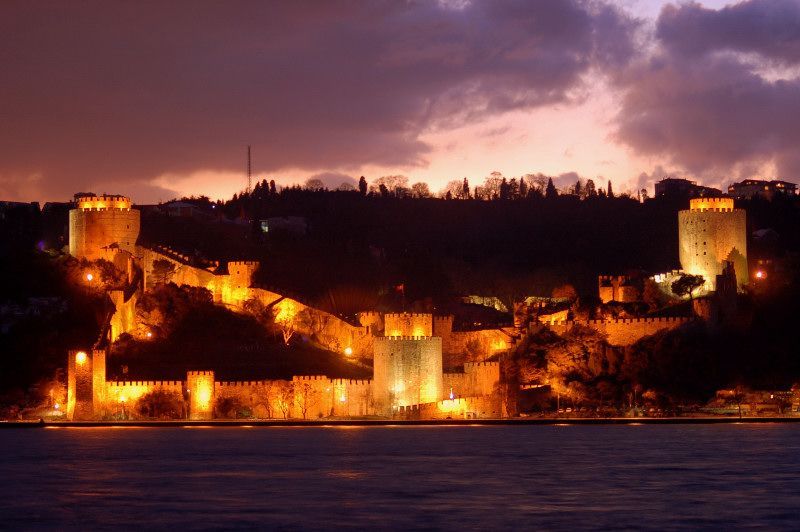
image credit: https://canduremre.wordpress.com
Rumeli Fortress is one of Istanbul’s most remarkable historical treasures. Designed by Sultan Mehmed II to control the Bosphorus, it played a crucial role in the Ottoman conquest of Constantinople. Built in just four months, the fortress showcases the Ottoman Empire’s impressive organizational and engineering skills.
The architecture, from Sarıca Pasha Tower to the dodecagonal Halil Pasha Tower, reflects both military ingenuity and cultural significance. Its hillside layout and symbolic design add to its uniqueness. Despite ongoing restorations, the panoramic views of the Bosphorus, the gardens, and central courtyard make a visit worthwhile.
Planning your visit by arriving early, using accessible transportation, and combining the trip with a Bosphorus cruise or traditional Turkish breakfast enhances the experience. Rumeli Fortress is more than a military structure; it is a living testament to Sultan Mehmed II’s vision and an extraordinary feat of medieval engineering.


 Funİstanbul: Fun-Filled Istanbul Travel Blog
Leave a reply to Funİstanbul Cancel reply