
Rising dramatically above the European shore of the Bosphorus, Rumeli Fortress is one of Istanbul’s most impressive reminders of the city’s Ottoman past.
Built by Sultan Mehmed II in 1452, the fortress was designed to control ships passing through the Bosphorus in preparation for the Ottoman conquest of Constantinople. Construction began in March and was completed just a few months later, in August 1452.
Today, Rumeli Fortress is an open-air museum where you can explore its enormous towers, defensive walls, historic cannons, gardens and panoramic viewpoints overlooking the Bosphorus. Restoration work is still ongoing, and access to some parts of the fortress remains restricted for safety and conservation reasons.
We’ve created this comprehensive self-guided tour guide to help you navigate this historical marvel. Throughout this article, we’ll explore the fortress’s rich history, its strategic importance in the Ottoman conquest, and practical information including how to get to Rumeli Fortress, entrance fees, opening hours, and the best spots to enjoy the stunning Bosphorus views that make this site truly special.
The Story Behind Rumeli Fortress
Why Sultan Mehmed II built it
When Sultan Mehmed II returned to the Ottoman throne in 1451, the conquest of Constantinople was becoming his greatest ambition.
But there was a problem.
The Bosphorus was a vital route between the Black Sea and Constantinople. Byzantine and allied ships could potentially use the waterway to bring supplies and military assistance to the city.
Mehmed understood that controlling the Bosphorus would be essential to his plans.
So he ordered the construction of a massive fortress on the European shore, directly opposite the older Anadolu Fortress on the Asian side.
Together, the two fortifications created a powerful strategic position at one of the narrowest points of the Bosphorus.
The fortress was originally known as Boğazkesen, a name that can be translated as “cutter of the strait”, an appropriate name for a stronghold built to control the waterway.
A Fortress Built in Extraordinary Speed
The speed of Rumeli Fortress’s construction is one of the most remarkable parts of its story.
According to official museum sources, construction began in March 1452 and was completed in August of the same year.
Around 300 master craftsmen, 700–800 workers, and 200 coachmen, boatmen and transporters are recorded as having worked on the project.
Think about that for a moment.
A huge stone fortress was rising on the steep slopes of the Bosphorus while Mehmed II was preparing for one of the most consequential military campaigns in history.
The fortress was not simply built to look impressive. Every part of its position and design had a purpose.
From here, Ottoman forces could monitor ships travelling along the Bosphorus and make it extremely difficult for vessels to pass without permission.
Rumeli Fortress and the Conquest of Constantinople
By the time Mehmed II launched his campaign against Constantinople in 1453, Rumeli Fortress had become an important part of the Ottoman strategy.
Its position opposite Anadolu Fortress gave the Ottomans control over the narrowest section of the Bosphorus.
The fortress helped them:
- monitor ships travelling through the strait
- restrict maritime movement toward Constantinople
- protect the Ottoman side of the Bosphorus
- strengthen the military preparations for the siege
The conquest of Constantinople followed in May 1453.
After the city fell, Rumeli Fortress gradually lost its original military importance. Centuries later, it was used for other purposes, including as a state prison.ith walls reaching 5.70 meters in thickness. Notably, both Sarıca and Halil Pasha towers contain nine floors, whereas Zağanos Pasha Tower houses eight.
Exploring the Fortress
Rumeli Fortress is not a perfectly symmetrical castle.
Instead, its walls and towers follow the natural shape of the steep hillside overlooking the Bosphorus.
This gives the fortress a dramatic appearance and it also reveals how carefully the builders adapted the structure to the terrain.
Three enormous towers dominate the fortress.
The Three Great Towers
Çandarlı Halil Pasha Tower
The tower associated with Grand Vizier Çandarlı Halil Pasha rises approximately 22 metres.
Zağanos Pasha Tower
The southern tower associated with Zağanos Pasha rises approximately 21 metres.
Saruca Pasha Tower
The tallest of the three, Saruca Pasha Tower, rises approximately 28 metres.
These three monumental towers, together with the fortress walls, smaller towers and defensive structures, created an imposing military stronghold overlooking the Bosphorus.
Gates, bastions, and secret passages
Throughout the fortress, I discovered an intricate network of entrances and defensive positions. Four main gates—Mountain Gate, Dizdar Gate, Hisarpeçe Gate, and Flood Gate—provided primary access. Additionally, a Cemetery Gate served as a secondary entrance. Most fascinating are the recently discovered underground passages, a magnificent find announced in 2025. These secret tunnels, extending at least 125 meters and possibly branching into multiple channels, may have served military purposes or functioned as drainage systems.
Architectural design adapted to terrain
Rather than forcing a symmetrical design onto the hillside, Ottoman engineers brilliantly adapted the fortress to the sloping landscape. The outer walls extend 250 meters north to south, with east-west lengths varying between 50 and 125 meters. This irregular shape demonstrates remarkable Ottoman expertise in environmental adaptation. Thirteen smaller watchtowers strategically positioned along the walls provided comprehensive surveillance of both land and sea approaches.
Symbolic layout resembling Arabic script
From an aerial perspective, the fortress reveals an additional layer of meaning, its layout intentionally resembles Arabic script. Some scholars suggest the fortress was designed to be read as “Muhammad” when viewed from above, whereas others claim it represents the initials of both Mehmed and Muhammad. This symbolic dimension adds cultural significance beyond the structure’s military purpose.
What to Expect During Your Visit
Upon arriving at Rumeli Fortress, you’ll discover a historical site undergoing significant transformation. Since April 2021, Istanbul Metropolitan Municipality has been conducting extensive restoration work to revitalize this medieval masterpiece.
Which areas are open to the public
Rumeli Fortress is open to visitors, but not all areas of the fortress are currently accessible.
The gardens, central areas and designated visitor paths can be explored, while access to the fortress walls and towers is currently restricted because of ongoing restoration and safety work. The exact areas available to visitors may change as restoration progresses.
Even with these restrictions, you can still appreciate the scale of the fortress, explore its accessible areas and enjoy the panoramic views of the Bosphorus from the designated viewing terraces.
Current restoration efforts and limitations
Rumeli Fortress is still undergoing restoration and conservation work in 2026.
The project focuses on preserving the historic structure while making the fortress safer and more accessible for visitors. Because work is continuing, you may encounter restoration areas, temporary barriers or sections that are closed during your visit.
For this reason, don’t rely on older guides that describe climbing all the towers or walking along the fortress walls. Visitor access can change as different parts of the restoration are completed.
The good news is that the fortress remains open as a museum, and there is still plenty to see, from its enormous towers and defensive architecture to its gardens, historical exhibits and spectacular Bosphorus views.
Panoramic views of the Bosphorus
Above all, the panoramic vistas make every visit worthwhile. From elevated vantage points, you’ll enjoy breathtaking views of ships navigating the strait, the Bosphorus Bridge, and Istanbul’s distinctive skyline.
Rumeli Fortress opening hours and best times to go
The official museum information currently lists:
Summer season — April 1 to October 2
09:00–19:30
Last ticket: 18:30
Winter season — November 1 to March 1
09:00–17:00
Last ticket: 16:00
Closed on Mondays.
Because museum hours can change seasonally, it is always worth checking the official museum listing before your visit.
For an optimal experience, arrive early morning around opening time when crowds are minimal, lighting is ideal for photography, and summer temperatures remain pleasant.
Planning Your Self-Guided Tour
Preparing for your visit to Rumeli Fortress requires attention to a few practical details that will enhance your experience at this historic site.
How to get to Rumeli Fortress
Reaching the fortress is straightforward with several transportation options:
- By Bus: From Sultanahmet, take the T1 tram to Kabataş terminal station, then catch bus 22 or 25E to Rumeli Hisarı stop. From Taksim, take busses 40, 40T, or 42T directly to Rumeli Hisarı.
- By Metro: Use the M6 line to Boğaziçi Üniversitesi/Hisarüstü station, then walk down to the fortress.
- By Ferry: Public ferries depart from Eminönü port to Emirgan, with just a 7-8 minute walk to the fortress.
- By Car: Simply use GPS navigation to reach the fortress, with parking typically available nearby.
Rumeli Fortress entrance fee and ticket tips
The entrance fee is 6 Euro per person as of 2026. No food is allowed inside (only water), so plan accordingly. Museum Pass Istanbul or Turkiye E-card is valid. Children aged 0–8 who are foreign nationals are free.
What to bring and wear
Comfortable footwear is essential as you’ll be navigating steep stairs and uneven paths. Bring water, particularly during summer months, plus a camera for capturing the panoramic Bosphorus views. A light jacket is recommended as the area can be quite windy.
Nearby cafes and breakfast spots
The area is famous for traditional Turkish kahvaltı (breakfast) served until late afternoon. Kale Cafe, opening early morning, is particularly renowned. Lokma restaurant by the waterfront and Rumeli Kale Cafe & Restaurant, famous for its pastries with spinach since 1983, offer delicious Turkish breakfast spreads.
Combining with a Bosphorus cruise
Several Bosphorus cruises include Rumeli Fortress as a stop. Especially convenient is making the fortress part of your itinerary after a northward Bosphorus cruise. Some Thursday cruises include a 45-minute visit to the fortress, creating a perfect land-water experience of Istanbul’s historical waterway.
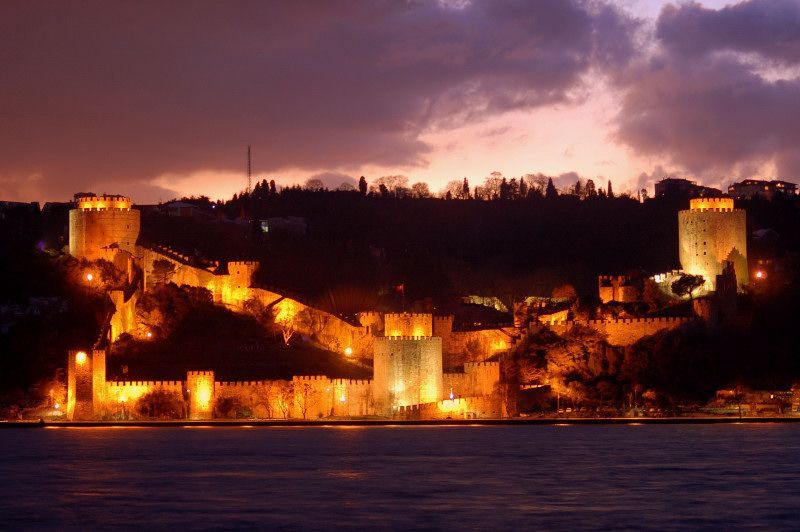
image credit: https://canduremre.wordpress.com
Rumeli Fortress is one of Istanbul’s most remarkable historical treasures. Designed by Sultan Mehmed II to control the Bosphorus, it played a crucial role in the Ottoman conquest of Constantinople. Built in just four months, the fortress showcases the Ottoman Empire’s impressive organizational and engineering skills.
Planning your visit by arriving early, using accessible transportation, and combining the trip with a Bosphorus cruise or traditional Turkish breakfast enhances the experience. Rumeli Fortress is more than a military structure; it is a living testament to Sultan Mehmed II’s vision and an extraordinary feat of medieval engineering.


Leave a Reply