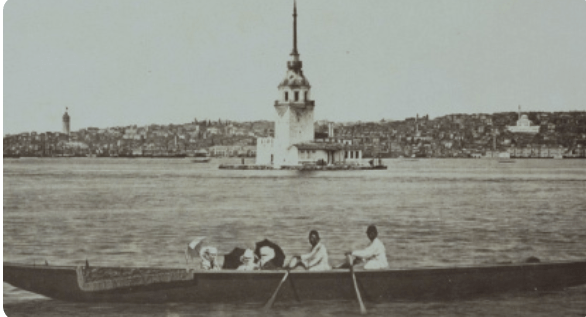
This elegant structure, the symbol of Üsküdar, stands at the mouth of the Bosphorus, just 200 meters from the shore.
According to an old legend, the mythological hero Leandros was in love with Hero, a priestess of Aphrodite (Venus) who lived in the city of Sestos on the European side of the Hellespont (today’s Dardanelles). Leandros, the son of the king of Abydos on the opposite shore, would swim across the strait every night to meet her. One stormy night, guided by Hero’s torch, he drowned in the waves. When Hero discovered his body washed ashore the next morning, she threw herself into the sea in despair. This tragic love story, first told by the poet Musaeus long before Horace (3rd century BC), inspired later writers and even Lord Byron, who swam across the Dardanelles in 1810 to prove it was possible.

Centuries later, in 1845, a French writer adapted this story to the Maiden’s Tower. In his version, Hero would secretly row from Üsküdar’s coast to the small islet, light a fire, and signal her lover waiting in Sarayburnu. One stormy night, Leandros never arrived. Finding his body the next morning, Hero leapt into the water. Her grieving father, the lord of Üsküdar, erected a monument on the islet, what we now know as the Maiden’s Tower.

Other tales are also tied to the tower. In 411 BC, Athenian general Alcibiades established a customs station here to control passage through the Bosphorus. Later, it is said that Athenian general Chares buried his wife Damalis here after she died in Üsküdar. A statue of a cow was erected on the nearby promontory, which became known as Damalis Cape.
A more famous Byzantine legend tells of an emperor who had a beautiful daughter. A prophecy warned she would die from a snake bite, so he locked her away in a tower in the middle of the sea. But destiny could not be avoided, a snake hidden in a basket of grapes sent to the tower bit and killed her.
In Ottoman tradition, Evliya Çelebi(Chelebe) recounts that the folk hero Battal Gazi loved the daughter of the lord of Üsküdar. When the girl was hidden in the tower to protect her, Battal Gazi returned from his campaigns, stormed the tower, seized both the girl and the treasure, and escaped.
Historically, the Maiden’s Tower was rebuilt and transformed many times. Its current form dates back to the reign of Sultan Mahmud II (1832–33). Set on a small rocky base of about 36 meters across, the fortress features a square tower topped with a domed pavilion and balcony. Above the entrance still hangs the imperial tughra of Mahmud II, inscribed with the year 1248 (1832–33).
Have you seen how deep the history of this tiny tower, all alone in the middle of the sea, is? Just like in the nostalgic photo. Wouldn’t you like to go there by boat one day in old Istanbul?⛵
Visiting details are available on the official website: https://kizkulesi.gov.tr/en/visit
 Funİstanbul: Fun-Filled Istanbul Travel Blog
Leave a comment